Initial Analysis
I first dreamed up the idea for this project while quarantined in the Jackson, WY Super 8 with the flu after a ski trip. What better way to pass my time stuck a hotel room than to play online poker all day and eat my weight in popcorn from the machine in the lobby? Truly a rejuvenating mountain retreat; the flu virus never stood a chance. In my feverish state, I justified the extensive amount of online poker I was playing by telling myself that I would someday download and analyze the hand history to improve my game. That day has come!
This is my initial analysis of my hand history. All 6max, mostly 5NL, some 10NL (full flu fever dream yolo mode).
Analysis of my opponents is a large part of my vision for this project. A unique aspect of Ignition is that players are anonymous. This is great for beginners like me—it keeps competition soft and makes HUDs largely ineffective. But another benefit that many people do not realize is that the anonymity allows Ignition to include hole cards for ALL opponents even if they folded in the downloadable hand history. I expect that this data will provide extremely valuable intel on the player pool.
As much as I want to understand my opponents’ tendencies, I must first look at my own stats.
“In order to understand your opponent, you must first understand yourself.” -Ancient Chinese Proverb (probably)
With this wisdom in mind, I began by looking at my own stats. Spoiler alert: it’s ugly! I suck at poker.
My Stats from 3,500 hands
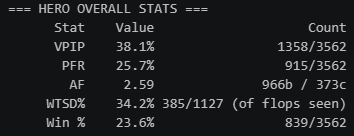
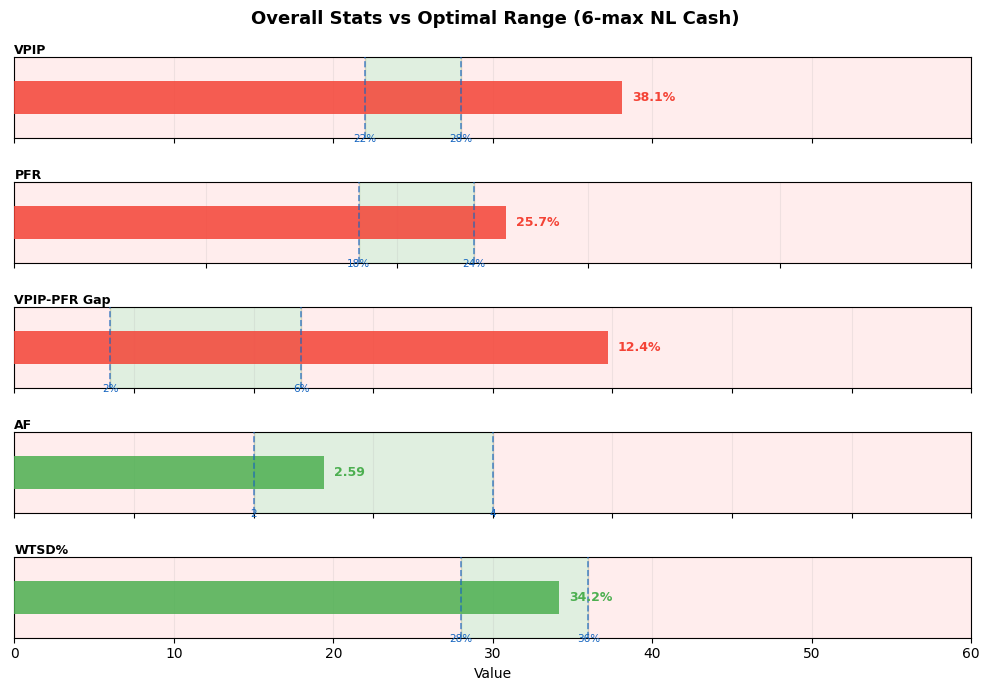
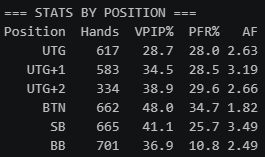
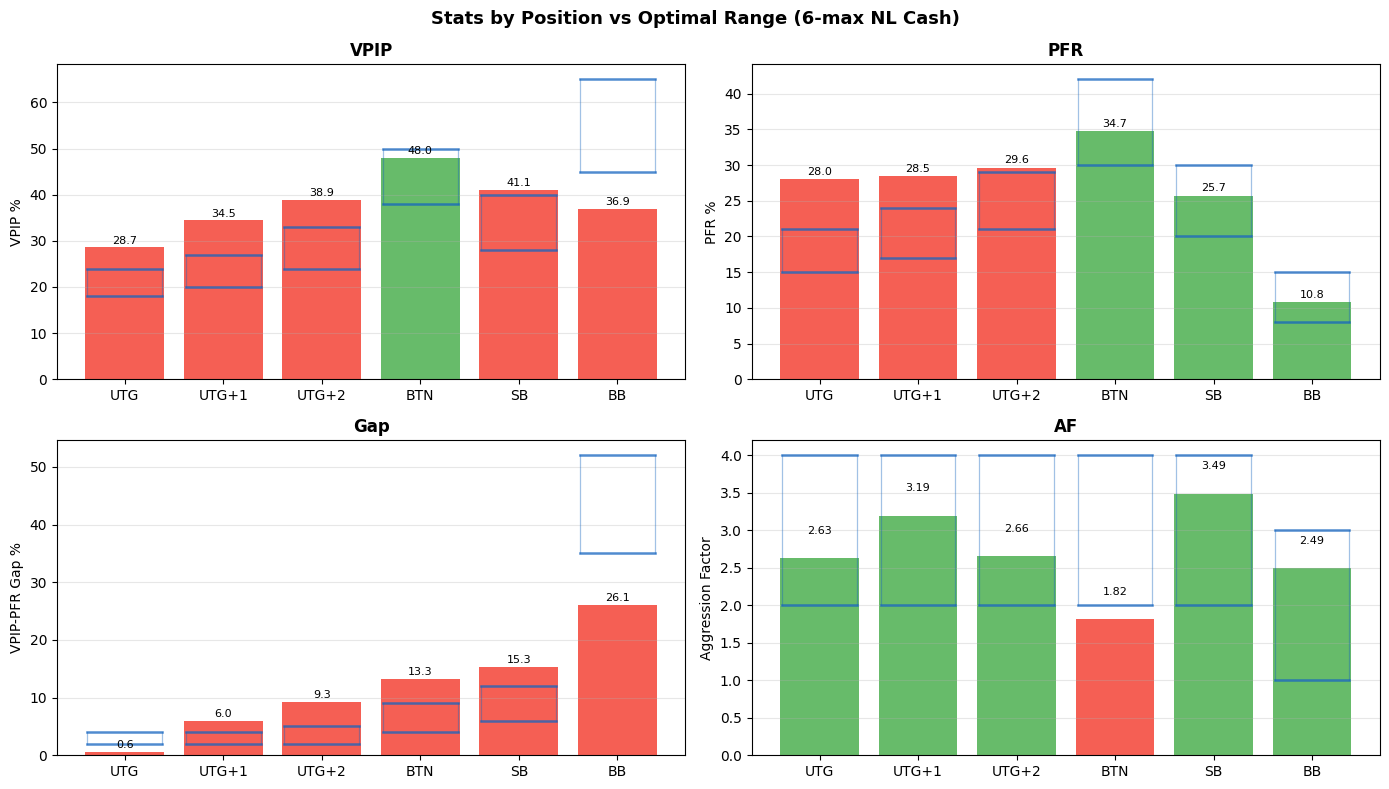
Below are my overall stats and stats by position. I have only included a few basic stats in this initial analysis. More to come soon. I also included charts with rough optimal ranges for where these numbers should be for a winning player.
Overall:
By position:
Review of My Stats
Positive Takeaways
(There are not many)
1. Positional Awareness
VPIP increases as I move closer to the button. This is good. I should be playing more hands when I am in position.
Specifically UTG, my VPIP (28.7) is nearly equal to my PFR (28.0). This reflects a raise or fold strategy—almost never want to limp UTG.
2. Aggression Factor (AF)
AF of 2.59 is in the healthy range.
Areas for Improvement
(There are many)
1. TOO LOOSE!
My overall VPIP of 38.1 is far too high. I am playing way too many marginal hands. This is true at every position. PFR is also a bit too high.
I am playing too loose preflop and not even making up for it with increased aggression. Not a profitable strategy.
2. VPIP/PFR Gap
The difference between my overall VPIP (38.1) and PFR (25.7) is off the charts—12.4. This indicates a lot of cold calling and limping behind. These are generally losing strategies—they cap my range and corner me into a transparent fit or fold strategy postflop.
Limping is a very common strategy used by micro stakes players on Ignition. Although limping is not GTO, it is a difficult strategy to play against—very wide ranges and lots of multi way pots. I have been limping behind with marginal and strong hands that are not great candidates for a raise/steal attempt with the goal of seeing a flop with position on the limper(s). Perhaps the more disciplined and profitable response to limpers is to attempt to steal for value with strong hands but fold those marginal hands and let the limpers battle it out amongst themselves.
3. Poor preflop play in the blinds
I am overplaying the SB. Meanwhile I am letting my big blinds be stolen far too frequently. I need to defend wider. I am probably also too aggressive in the BB given that my AF in that seat is similar to most others. I should be raising less OOP and just seeing flops before committing myself.
This particular stat makes me curious to look at stats from my more recent sessions, because defending the big blind is something I have become more aware of lately. I wonder if my low BB VPIP is skewed by poor play earlier in my career. More broadly I should be tracking not only overall stats, but also rolling stats to evaluate my most recent performance and trends.
4. Wasting the Button
My lowest AF is on the button. Least aggressive play + best seat = losing strategy. I need to take control more from the button.
More broadly my aggression should increase as I improve position and decrease when I am in the blinds. Right now it is all over the place; if anything it is the opposite.
Takeaways
I have one simple, major takeaway from my initial review of my stats.
1. Back to Basics - Pre Flop Ranges
I need to study and practice my 6max preflop opening ranges. I need to be more patient and get those VPIP numbers down at every position. The blinds are my worst seats, so I need to focus specifically on studying fold / 3bet / defend ranges for those positions.
I also need to click the call button less, especially in MP and BTN. Raise or fold should be the two main options I am considering for any pre flop decision. Call / limp behind are outliers. My gap between VPIP and PFR needs to narrow dramatically.
I am putting myself at a major disadvantage by not playing soundly preflop. I need to fix these preflop leaks in order to put myself in the best possible position to succeed postflop.
Next Steps
The next steps are:
- Study preflop ranges, particularly the blinds
- Review some specific hands
- Play a few sessions to put the study into practice
- Integrate more stats into the review to better understand the strengths and weaknesses of my game
I plan to build out this stats review next week. The next version will look at more stats for both pre- and post-flop.
Preflop:
- 3bet %
- Fold to 3bet
- ATS
- Fold to BB Steal
Post flop / Showdown:
- Cbet %
- Fold to Cbet
- Check-Raise %
- W$D%
- WWSF